Back in October 2020, the concept of what eventually became PA-ADOPT was starting to be discussed around West Chester University’s Office of Digital Learning & Innovation (now the Teaching & Learning Center) and the Office of Research & Sponsored Programs. The idea to bring four Pennsylvania state system universities together to apply for a U.S. Department of Education (DOE) grant aimed at creating free and open electronic textbooks was an ambitious one, but having already established an eTextbook program for faculty that had been successfully generating books for four years, we liked our chances.
Fast-forward six years later, we have 22 new eTextbooks from a variety of STEM and Writing fields thanks to the DOE’s Open Textbooks Pilot Program The data collected from these books so far is showing that they’ve had the effect we thought they would: average GPA up, average failure and withdrawal rates down, and hundreds of thousands of dollars saved by the students in the four Pennsylvania universities that used them. Beyond that, these books have been used at over 100 educational institutions around the world, cited in other scholarly works, and have received high marks in reviews from other higher education faculty.
While it had been my hope to find a way to continue and possibly even expand this program after the grant ended in August 2026, I’m sorry to say that the decision has been made to end it. I am extremely proud of everything we have accomplished and will continue to look for ways to help meet the needs of faculty and students by building OER textbooks.
So, what exactly does this mean going forward?
- No new books will be produced by PA-ADOPT.
- The PA-ADOPT web site will remain online for the foreseeable future, continuing to make our existing books available for download.
- While there will no longer be an organized method of supporting our faculty authors, they are free to make updates to their books on their own, and we will continue to be available to provide those updated files on this site.
- Users are welcome to contact us about any issues they’ve encountered with our books, and we will pass those on to the faculty authors, but there is no guarantee that they will be fixed.
My thanks to everyone who has been a part of this program and who has used (and continues to use) our books. It has been an unforgettable and rewarding journey.
Marc Drumm
Principal Investigator, PA-ADOPT

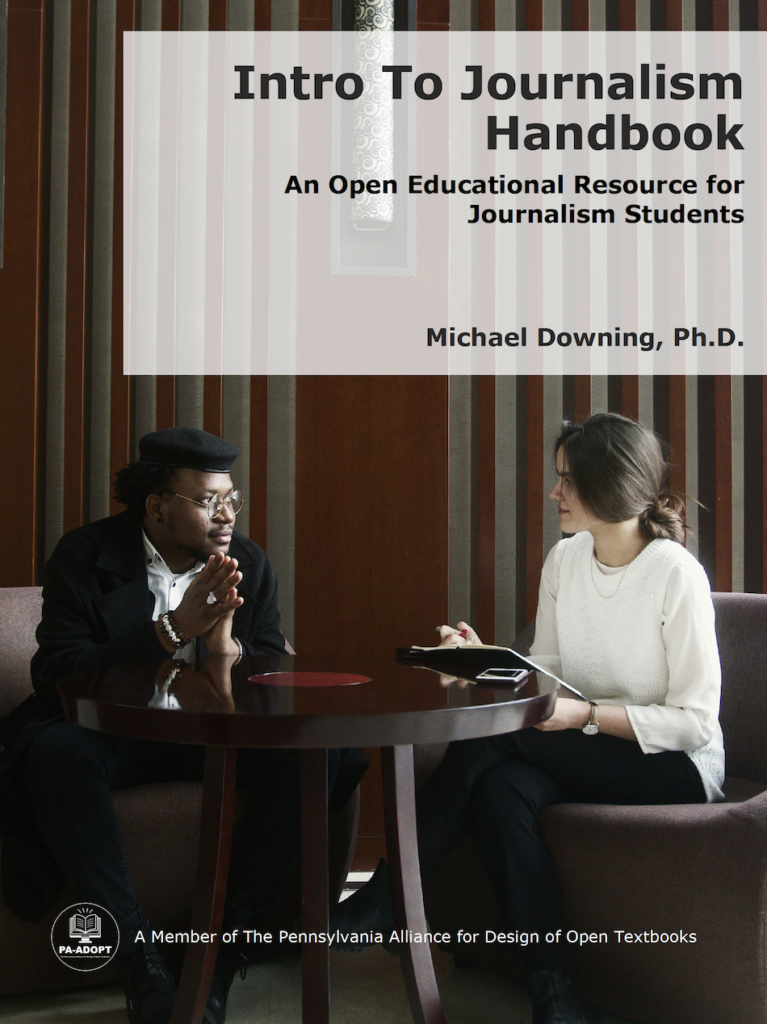
The Pennsylvania Alliance for Design of Open Textbooks (PA-ADOPT) is pleased to announce the immediate availability of our fifth free and open eTextbook: Intro to Journalism Handbook: An Open Educational Resource for Journalism Students by Dr. Michael Downing, Professor of English at Kutztown University.
“This book is intended as an open educational resource for beginning journalism students. It contains information on such topics as the First Amendment, 5 Ws (and H), the inverted pyramid, headlines and subheads, AP and in-house style, writing and editing exercises, and guidance on strategies for covering various stories and/or events.
This book essentially replicates the structure of the author’s journalism classes, which are writing-intensive classes. As such, it focuses upon helping student writers begin working on reasonably serious, campus-level journalism assignments as quickly and effectively as possible. The goal is to submit stories, photos, and occasionally video to a university newspaper for publication, all the while following professional standards related to accuracy, clarity, grammar, and AP style.”
Please help us spread the word about our books and web site to further our work to reduce costs for students, bring equity to higher education classrooms, and give faculty the flexibility to design their own learning experiences. All of our books are available to download in both ePub and PDF formats from our Bookshelf.
Intro to Journalism Handbook: An Open Educational Resource for Journalism Students
by Michael Downing, Ph.D.
Keywords: Journalism, Writing, News, Reporting, Newspapers
About the Book
This book is intended as an open educational resource for beginning journalism students. It contains information on such topics as the First Amendment, 5 Ws (and H), the inverted pyramid, headlines and subheads, AP and in-house style, writing and editing exercises, and guidance on strategies for covering various stories and/or events.
This book essentially replicates the structure of the author’s journalism classes, which are writing-intensive classes. As such, it focuses upon helping student writers begin working on reasonably serious, campus-level journalism assignments as quickly and effectively as possible. The goal is to submit stories, photos, and occasionally video to a university newspaper for publication, all the while following professional standards related to accuracy, clarity, grammar, and AP style.
Chapters
- Introduction
- Key Concepts in Journalism
- Format and Style
- Obits, Hard News, Press Releases, Sports, Options
- Checklists for Covering Various Stories
- The Impact of Social Media on Journalism
- Artificial Intelligence and Journalism
- Journalistic Code of Ethics
- Careers
- BLS: New Analysts, Reporters, Journalists
- Exercises, Self Tests, and Useful Tools
- Resources
- Appendix
Usage
Readers
The eTextbooks created as a part of this program are provided in two formats: ePub and PDF. Please refer to our Reader Support section for guidance on which format may be best for you and the device(s) you use.
Instructors
If you are an instructor seeking to use this eTextbook in your own course(s) please feel free to download the ePub and/or PDF file(s) for your use, but make sure to complete our eTextbook Usage Survey (this information is used for program evaluation purposes).
If you are interested in making revisions and edits to this eTextbook please note that this is possible since the book is under a Creative Commons License, which allows you to remix, reuse, revise, and redistribute the eTextbook. Please refer to the Faculty Support Page, specifically looking at Remixing. You can download Intro to Journalism Handbook: An Open Educational Resource for Journalism Students Apple Pages File in order to use the original document to revise and remix the eTextbook for your purposes.
Citations
MLA: Downing, Michael. Intro to Journalism Handbook: An Open Educational Resource for Journalism Students. First, The Pennsylvania Alliance for Design of Open Textbooks (PA-ADOPT), 2024.
APA: Downing, M. (2024). Intro to Journalism Handbook: An Open Educational Resource for Journalism Students. (First). The Pennsylvania Alliance for Design of Open Textbooks (PA-ADOPT).
Chicago: Downing, Michael. Intro to Journalism Handbook: An Open Educational Resource for Journalism Students. First. The Pennsylvania Alliance for Design of Open Textbooks (PA-ADOPT), 2024.
Peer Review
This eTextbook went through an Open Peer Review process. The peer review process used the Open SUNY Textbook Peer Review Guidelines, allowing peer reviewers to read the text carefully and evaluate the following:
- Educational Significance of Content including accuracy, appropriate and useful materials, valid and significant concepts, models, and skills, and key elements;
- Effectiveness as a Teaching Resource including a clear explanation of the concepts, alignment of materials to the learning process of the target audience, and alignment of the learning objectives with course goals; and
- Readability and Ease of Use including clarity and comprehensiveness, consistent writing style, readability and ease of use (logic, sequence, and flow), appropriateness for target readership level, and quality of Interactivity and multimedia learning objects.
As a part of the open peer review process, the public review conducted by Dr. Robert M. Folk is made available: Peer Review Document (PDF).

If you’re planning to attend the upcoming OLC Innovate conference in Denver, stop by to hear Marc Drumm, PA-ADOPT’s Principal Investigator, and Hannah Glatt, Learning Experience and eTextbook Designer, present “How a University’s eTextbook Development Program Became a Multi-Institutional OER Consortium: PA-ADOPT” on Friday, April 12 from 11:15am to noon MT. We’ll talk about the approach we took to introducing West Chester University faculty to producing their own eTextbooks, the methods we use and topics we teach, and how this eventually led to receiving a grant from the U.S. Department of Education to expand this program into leading four Pennsylvania State System of Higher Education (PASSHE) institutions in a three-year project to create OER eTextbooks focused on Science, Technology, Engineering, Mathematics, Health, and Writing courses.
PA-ADOPT’s Marc Drumm, Hannah Glatt, and Dr. Jordan Schugar had to opportunity to discuss the WCU eTextbook Initiative and PA-ADOPT in the April 5th, 2023 episode of ODLI on Air from West Chester University.
Episode Description: Marc Drumm and Hannah Glatt from the Office of Digital Learning and Innovation share what goes into designing and creating a digital textbook for both the eTextbook Initiative and PA ADOPT Grant at West Chester University. Dr. Jordan Schugar weighs in on what motivated him to participate in both of these and how students can benefit from faculty creating their own textbooks.
Take a listen to ODLI on Air: Apple | Spotify. Closed Captioning available via the Spotify link.
Check out the PASSHE Connectivity Bulletin Article by Loretta MacAlpine “PA-ADOPT: Four System Schools Collaborate to Close Equity Gap” The article discusses that the State System has maintained frozen tuition for four years but faces a challenge with expensive textbooks, especially for Pell-eligible students. To address this, a consortium of four universities in Pennsylvania established the PA-ADOPT program. With funding from the U.S. Department of Education, this initiative aims to create Open Educational Resources (OER) and open electronic textbooks. The program focuses on STEM-H and high-enrollment writing courses. Led by Marc Drumm from West Chester University, faculty members are trained to develop quality eTextbooks, aiming to save students an estimated $400 annually. These eTextbooks will be openly licensed for wider use and modification. The project, targeting more than the initially proposed 24 eTextbooks, is set to conclude in August 2024, funded by a $918,000 grant from the Fund for the Improvement of Postsecondary Education (FIPSE).